

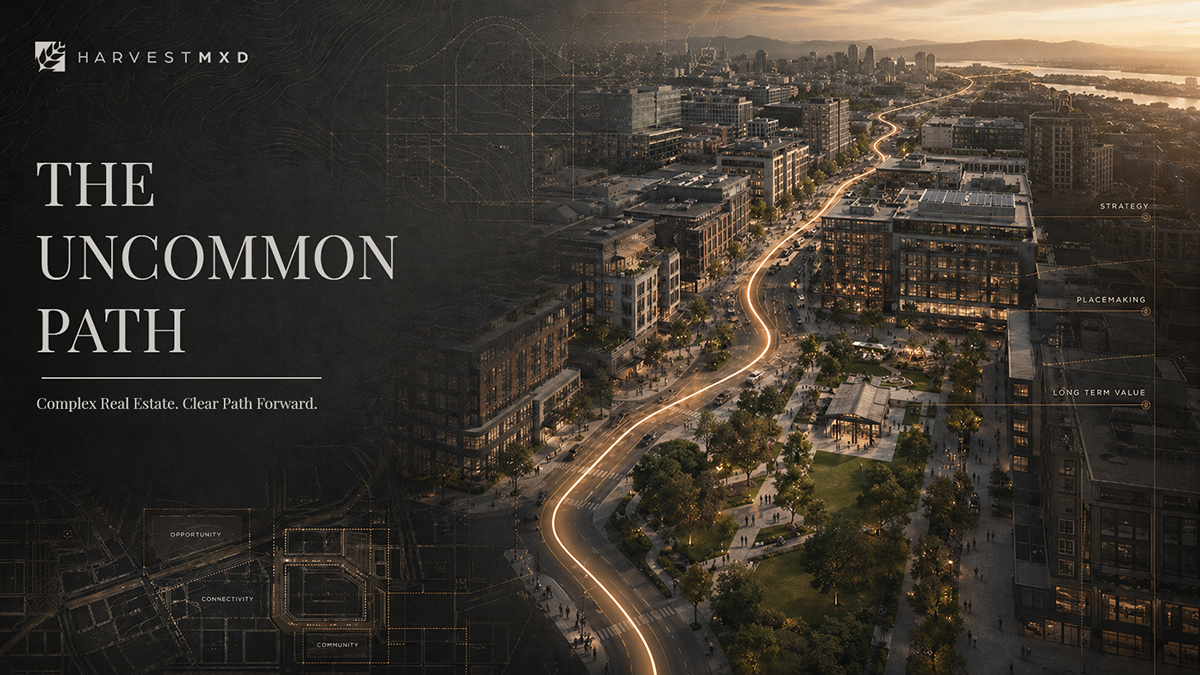
THE UNCOMMON PATH
In complex real estate, the obvious path rarely creates the most value.
The easy answer is usually to list the property, sell to the highest bidder, move quickly, and let the market decide. That approach can work for simple assets. But complex real estate is different.
When a property involves community sensitivities, entitlement risk, infrastructure needs, mixed-use potential, long-term control, capital constraints, public incentives, and multiple stakeholders, the obvious path can leave significant value behind.
The uncommon path takes more work.
It requires strategy before marketing, alignment before execution, and structure before transaction. It often requires understanding how public-sector priorities, infrastructure funding, tax increment financing, grants, fee reimbursements, or other incentive tools can support a better outcome; and when done correctly, it creates value that a conventional process may never reveal.
That is the perspective behind The Uncommon Path, Harvest MXD’s insight series on complex real estate, clear strategy, and value creation.
Complexity Is Not the Problem
At Harvest MXD, we do not view complexity as a reason to avoid an opportunity.
In many cases, complexity is where the opportunity exists.
The best opportunities are often overlooked because they are difficult to understand, difficult to position, or difficult to execute. A property may be underutilized because the entitlement path is unclear. Infrastructure may be needed before the private market can fully respond. A public or institutional owner may need to balance financial return with stewardship, community impact, and long-term control.
That does not mean the asset should be avoided.
It often means the value has not yet been uncovered, organized, or clearly communicated.
The uncommon path is the disciplined search for the strategy that creates the clearest path forward.
Strategy Comes Before the Transaction
One of the most common mistakes in complex real estate is going to market too early.
Before a property is sold, leased, developed, or capitalized, the owner should understand the strategic options available.
Is the best outcome a sale, ground lease, joint venture, public-private partnership, or long-term hold?
Are there entitlement, infrastructure, access, zoning, title, or design issues that need to be solved first?
Could public incentives, infrastructure reimbursements, tax increment tools, or other public-sector partnerships help unlock feasibility and create broader public benefit?
When those questions are not answered upfront, the market fills in the blanks.
And the market usually discounts uncertainty.
A clear strategy reduces that uncertainty. Reduced uncertainty creates value.
The Highest Bid Is Not Always the Best Path
In a conventional transaction, the highest price often appears to be the best outcome.
But in complex real estate, the highest bid may not always be the best path to maximum value.
A buyer may offer the most money but lack the ability to execute. A developer may understand the site but need public-sector alignment before committing capital. A public owner may receive a strong sale price but give up long-term control, future participation, or the ability to shape community outcomes.
Sometimes the best structure is not an outright sale.
It may be a ground lease that preserves ownership while creating long-term income. It may be a joint venture that allows the owner to participate in upside. It may be a public-private partnership that aligns civic goals with private execution. It may be a phased disposition, master developer process, incentive strategy, or pre-market alignment effort that improves the opportunity before the market ever sees it.
The uncommon path is about choosing the structure that fits the asset, the owner, the public context, and the long-term objective.
Clarity Is the Outcome
The uncommon path is not about making real estate more complicated.
It is about making complex opportunities actionable.
At Harvest MXD, we believe the path forward becomes clearer when the right work happens early: understanding the asset, defining ownership goals, evaluating market realities, identifying constraints, aligning stakeholders, testing structures, assessing public incentive opportunities, and preparing the opportunity for execution.
The clear path forward is the outcome.
The uncommon path is how you get there.
That distinction matters.
A clear path is not always the shortest path. It is not always the easiest path. And it is not always the path the market expects.
But it is the path that gives an owner the ability to make informed decisions, reduce uncertainty, align public and private interests, and move forward with confidence.
Introducing The Uncommon Path
The Uncommon Path is Harvest MXD’s insight series on complex real estate opportunities — where the obvious answer is rarely the most valuable one.
Through this series, we will share perspective on mixed-use development, public-sector real estate strategy, land monetization, capital formation, public-private partnerships, public incentives, placemaking, transaction structure, and the practical realities of getting difficult opportunities unstuck.
Because in complex real estate, the goal is not simply to move fast.
The goal is to move proactively, deliberately, and confidently.
In complex real estate, the uncommon path is often the clearest way to maximize value.